Welcome to the Kiva's Blog


We will be featuring blog posts from many departments. Comments are encouraged but moderated.

Wednesday, October 31, 2012

The Season of Rain and Chanterelles


Well, here it is: after a record-breaking dry spell, the old familiar cold and rain have finally arrived.  Some of us love it; some of us hate it; and some of us tolerate the long grey months because we know that they have their rewards.

A match made in Heaven
Rewards?  Yes, there are a few.  What's rain in the valley is usually snow in the higher elevations, providing sport for skiers and snowboarders.  After we wait out a soggy winter we often have a beautiful spring (a little lacking in recent years) and wonderful summers, for a start.   

And for the intrepid hiker who isn't afraid of damp feet and slippery footing, Oregon's forests can be beautiful in the rainy season, and the many species of fascinating and edible mushrooms that spring up when the rain comes down are a reason to welcome the wet.

Of the wealth of the Northwest's wild mushrooms, one of the most versatile--and certainly the best-known--is the Chanterelle.

Rob Miller has been the Kiva's major supplier of chanterelles for about a decade--often our sole supplier.  Our produce department likes the fresh, clean, sound mushrooms he brings us, as well as his reliability and his sensitivity to the areas in which he picks.

"I don't like to work with intangibles," he says; he made the choice long ago to be out in the weather hunting for chanterelles rather than sitting behind a desk shuffling numbers.  Rob says he loves to spend time in nature and take longs walks in the forests where he harvests fungal delicacies; he needs time in the wild to be happy.  This is especially lucky this year, since unusual weather (the long, late-summer dry spell followed by not only rain, but cold) has made this year's mushroom crop scarce and harder to find--the worst year for picking that Rob has seen. 

Since we don't all have the time, ability, or know-how to go on those long walks ourselves, many of us rely on the convenient commercial availabilty of chanterelles and other wild mushrooms.  Having someone else do the legwork can be well worth the time and effort saved for busy folks, even though this year's smaller harvest has driven prices up.
Chanterelles have a nutty, savory, delicate flavor with wide appeal--varieties of this mushroom grow in the northerly areas of Europe, Asia, and America, and they're relished in many different cuisines.  There are endless ways to prepare and enjoy them; a quick search for "chanterelle recipes" on Google yielded 42,000 hits! 

Chanterelle recipes are easier to find than mushrooms, but in search of more, I solicited recipes from Kiva employees this week and got some to add to the record.

A caveat:  these are not recipes written or tested by professional chefs, so use your own judgement.  Your mileage may vary!

The simplest came from Tom, our local grocery buyer.  He likes to slice, pan-fry, and eat chanterelles before they leave the skillet.  It doesn't get easier than that! 

Dave, one of our produce managers, offered this recipe:

Dave's Kale with Chanterelle

Dave and a tasty friend

1 bunch Italian kale, chopped

A couple of medium-large chanterelles, halved

2 cloves garlic, minced

2 small or 1 large shallot, minced

A couple tablespoons olive oil

In a skillet, heat the oil over medium heat.  Add minced garlic, stir until garlic is translucent.  Add minced shallots, simmer until translucent.  Lower the heat and add the chopped kale.

In a separate pan, heat the chanterelles until they release liquid, then add them to the kale mixture.  Season to taste with sea salt and black pepper; serve immediately.

-----

Our wine buyer Ziggy makes this creamy Chanterelle Chicken every autumn at least once.  As you might expect, wine plays an important part in this dish. 

Ziggy's Chanterelle Chicken (serves 4 to 6)


2 boneless, skinless chicken breasts, browned and cubed (1/2 inch cubes)

About 1 lb chanterelles, chopped fairly small
Ziggy's Chanterelle Chicken Sauce ready to serve

Two very large or four small shallots, minced

2/3 to ¾  bottle of dry white wine for cooking

½ pint heavy cream or Half-and-Half

4 Tablespoons butter, give or take a little

A couple of Tablespoons of flour

Fettuccine pasta, preferably fresh


The proportions of this recipe are very flexible, and I vary them every time I make it with the same great results.

Melt the butter in a heavy-bottomed skillet until bubbling; add the minced shallots.  Cook until translucent (don’t let them brown), then add the chopped chanterelles.  Heat until mushrooms are cooked through and have released their liquid; cook a few more minutes, then add the white wine in dollops of about a cup and let reduce between each addition.  Allow some time for this; I generally let the shallot-chanterelle mixture simmer for an hour or more while adding wine slowly.  (Chanterelles, like many foods, have alcohol-soluble factors that release and develop flavor during cooking with wine.)
Note:  For cooking wine I used the Domino Pinot Grigio; any crisp, dry white wine would do, though for my personal taste I prefer not to use Chardonnay for cooking.  The usual caution about not cooking with wine you wouldn't want to drink applies; you don't want to cook with wine which is "off" or yucky.  However, I do often cook with wine which is simpler (and less expensive) than I usually want to sip with dinner.

Brown the chicken on a grill or in a separate skillet with a little additional butter or olive oil.  I usually cook it whole over medium or medium-high heat until the surface is browned, then cut it in cubes and brown the cut sides lightly.  The chicken can then be set aside while the shallot-chanterelle-wine mixture cooks down.

When the sauce is thickening but still contains a fair amount of liquid, add the browned chicken (the good stuff in the pan can be deglazed with a little wine and added along with the chicken) and simmer until the chicken is fully cooked.  The meat absorbs the flavor.

The flour is used to thicken the finished sauce; it can either be sprinkled lightly over the mixture and stirred in until the sauce gets a little dry, or a roux can be made in a separate pan or skillet (heat a little extra butter until bubbly; add the flour and cook for a few minutes without letting the mixture brown) and then added back into the main mixture.

After the sauce is thickened, add cream to taste (I like it to be a gravy-like consistency) and serve it over pasta.  (Pasta Plus’s fresh linguine is my favorite.)
Pear and Blue Cheese Salad
This is a traditional autumn recipe in my house, and I always pair it with an oaked Chardonnay which complements the savory woody notes of the mushrooms.  I recommend Stangeland for an Oregon Chardonnay (oaky but also floral and subtle with some crispness left), or J. Lohr’s Riverstone or Arroyo Vista Chardonnays for California wine.

I also always accompany the Chanterelle Chicken with a pear/blue-cheese salad.  Any pear of your choice can be sliced or cubed, topped with small pieces of blue cheese (I love the Fourme D’Ambert, which is sweet and nutty and complements fruit very well), and crushed roasted hazelnuts, covered with a balsamic vinaigrette and served on a bed of greens.


That's it for now.  Next week we'll be back with a few other recipes from familiar faces at the Kiva.  In the meantime,  tell us--what do you do with chanterelles?


Wednesday, October 17, 2012

Thinking Globally, Farming Locally

Cattail Creek Lamb Returns to Our Meat Section


The Kiva's meat selection focuses on local, naturally-raised products.  Our knowledgeable buyers Emma and Will deal directly with the farmers and ranchers who raise the animals rather than a central distributor, so their relationship with the food we sell is up-close and personal.


Local lamb producer Cattail Creek was one of the first suppliers the Kiva added when we first started carrying meat.  The mild flavor and tender texture made it an immediate hit with both families and restaurants in the area.  


After a hiatus of one and a half years, Cattail Creek Lamb is back on our shelves this month, and maybe better than ever. 


John Neumeister, Cattail Creek’s founder, has been a familiar face at the Kiva for a long time.  He was glad to answer all my questions when I called him last week, and had a lot of interesting things to say about food and how it’s produced.  John’s agricultural resumé is impressive: he grew up on a mixed sheep and cattle farm in Ohio; he has been raising lamb for thirty years since moving to Oregon; and has been involved in organic farming since the 1970’s.  He has degrees in animal and crop sciences from Oregon State University.  He co-authored the Certified Organic Standards for livestock which were adopted by Oregon Tilth and the National Organic Standards.  


Now in partnership with Farmland LP, a U.S. private equity fund whose mission is to acquire farmland and convert it to organic production, John is primarily in charge of marketing, while partners Craig Wichner and Jason Bradford oversee most of the operations, and the farms are managed by shepherd Mac Stewart--an all-star team whose qualifications are as formidable as Mr. Neumeister’s. 


I was impressed to find that Cattail Creek is more than a business enterprise--it’s a vision of community-supported, sustainable agriculture.  “We’re not looking for loopholes just to sell a more expensive product,” John told me.


It’s very literally a grassroots effort.  In John’s opinion, Cattail Creek has the strongest raising claim of any of the larger lamb-producing farms in the valley (most of which pasture their lambs on seed-producing or after-harvest fields that have been treated with chemicals), with 800 of its 900 acres--comprised of three properties between Corvallis and Philomath--certified organic, and the remainder transitional.


Sheep are designed by nature to be grazers, and better pasture produces better meat, so the conversion of commercial farmland to high-quality organic pasture is an important step.  Cattail Creek’s system encourages a wide variety of plant species in their pastures, such as cold-tolerant and drought-resistant grasses, legumes (which fix nitrogen in the soil), plantains, and chicory.  The land is never treated with chemicals, and rock powders are used as fertilizers.  The sheep make their contribution too, in the form of manure which cycles nutrients back into the soil.


Starting from the ground up, Cattail Creek is dedicated to humane care and handling of its animals.  They use no synthetic crop treatment and no GMO crops; lambs are 100% grass fed and free of antibiotics or hormones.


Although it’s a new enterprise, their breeding program assures that not only the lambs but their mothers as well eat a chemical- and GMO-free, 100% vegetarian diet, and are also free of hormones and antibiotics (animals which become sick and require treatment with antibiotics are removed from the program).  It’s their intention to find breeds of sheep which thrive best under local conditions and raise them through generations rather than buying lambs from brokers.


The advantage to consumers is obvious--the 100% grass-fed meat tastes better than the “muttony” lamb from a feedlot operation, but the benefits go beyond flavor.  Cattail Creek is diversifying their operations toward a goal of integrated holistic farming.  In addition to developing markets to utilize the byproducts of lamb production, they’ve incorporated a new poultry-raising project and added vegetable crops.  Some land is also leased to a hog farmer.  John hopes that Farmland LP may be a vision of the future of CSA (Community Supported Agriculture), where instead of having a farm subscription, the participants would be involved in a cooperative effort to acquire the land on which their food is grown. 


The Kiva is currently carrying Cattail Creek’s ground lamb, stew and kabob meat, lamb chops, and shoulder steak.  Sausage is expected to be available in November.


Cattail Creek’s meat is processed and packed by Century Oak Packing Co., a local company owned by Lonely Lane Farms. http://centuryoakpacking.com/html/contact_us.html


We’re lucky to live in an area with an abundance of sustainable agriculture, offering readily-available organic produce, meat, eggs, and dairy products.  It’s a luxury to be able to buy fresh, healthy food just one or two stops from the farm.  Welcome back, Cattail Creek!


For more information on Cattail Creek and Farmland LP, visit http://www.farmlandlp.com/

Thursday, October 4, 2012

Cheese and Wine Pairing for October


This month Josh and Ziggy, our representatives from the Deli and the Wine Department respectively, tried pairing Seeing Red Cabernet and Perrydale Aged Gouda from Salem’s Willamette Valley Cheese Company.


Josh says:  Perrydale ($18.70/lb.) is the Kiva’s newest offering from Salem’s Willamette Valley Cheese Company.  A blend of sheep’s milk from Roseburg’s Catsby  Farm and local cow’s milk, this cheese is made in the style of a gouda and aged for one year.  The aging process yields a beautifully complex flavor, but with a still-tender creamy paste; however, the most exciting aspect of this cheese is its use of sheep’s milk from one of Oregon’s two commercial sheep dairies.

Pairing notes:  The mellow acid of the wine and the slight tang from the sheep’s milk worked well together to balance the creamy richness of the cheese.

Ziggy says:  Seeing Red ($13.75) is Columbia Valley juice from Cartel Wine Group.  Seattle Magazine describes Cartel Wine Group as modern-day négociants who buy the wine left over after blending from large established Washington wineries and blend this high-quality surplus themselves.  The result is an affordable wine with the flavor profile of a more expensive bottle. 

Seeing Red is a lovely wine for autumn--very fruity and rich, with notes of cassis, ripe berries, herbs, and smoke.  My tasting partner and I also found a hint of astringency and a slight trace of bitterness--both qualities which can be a plus in a food wine.  (Other foods which might pair well with Seeing Red include red meats and stews, hearty tomato-based dishes, and sharp cheeses.)

My tasting partner disdains the “stinky” cheeses that I love, and Perrydale pleased us both.  We found it to be strong but not overwhelming, mellow, a little musky and mildly fragrant with a round, creamy, complex flavor profile.  I think it would pair very well with a number of medium- to full-bodied Spanish or Italian red wines.  While it might work with some robust whites and even sweet wines, I think it will go best with red.

Perrydale and Seeing Red made an enjoyable match.  The cheese brought out tannic notes from the wine; the wine brought out complex and subtle herbal and bitter notes in the cheese.  Lovely as an intriguing appetizer; satisfying as a savory dessert.


Tuesday, September 28, 2010

Alpenrose Dairy Field Trip


This past week Kiva dairy buyer Emma and stalwart dairy stocker Roger got a chance to visit Alpenrose Dairy.  The Kiva made the decision to switch to Alpenrose from Organic Valley because all of their milk is actually produced and processed here in Oregon.  Now that we have visited their operation in person, we are that much more excited to be carrying Alpenrose organic milk in our store.
Roger and Emma, excited to be touring the Alpenrose facilities!

Alpenrose was established in 1916 in Portland by the Cadonau family, and the company remains family run today.  The organic milk processed and sold under the Alpenrose name comes from one of three Oregon farms. We visited Mayfield Farm; the other two are Ridgerock and Country Lane Farms.  All three farms are owned by the Yeager family, and Chris Yeager was good enough to give us the tour of Mayfield Farm.  The Yeagers have owned the Mayfield farm for 2 1/2 years and the dairy herd consists of 75% Holstein and 25% Jersey cows.  A nine person crew runs the Mayfield farm.  There are 400 cows at Mayfield, 300 at Rockridge Farm and 450 at Country Lane Farm.  All the cows at the farms are certified organic and have been bred and raised on the farm.  Oregon Tilth is the certifying agency for Alpenrose's organic certification.

The daily routine is the same at all three farms, so allow us to share with you the life of a Yeager dairy cow.  The cows are milked first thing in the morning, then fed, bred (if it is the right time of the cycle for the individual cow) or pastured for at least eight hours to graze, then fed again before a final milking and bedtime.
All the cows receive at least eight hours of pasture time each day.  They are bred when they are from 15-22 months, if they meet the weight requirement.  Each cow is milked for 300 days a year and given 60 days off from milking.  All three farms hold the title of "Animal Welfare Approved" which means that they are inspected and certified by the Animal Welfare Society.  These are not factory farms.


The cows' supplemental feed consists of alfalfa, corn, barley meal, mineral supplements and protein meal (the protein meal is sourced from flax, canola or sunflower when available; soy is only used when the other three are not available, and even then the soy is non-GMO and grown in the U.S.).  The corn is grown on the farm, and overall, 75% of the feed is grown in Oregon!

Of course, this feed is only supplemental.  The 130 acres of the Mayfield farm are broken into 27 different grazing pastures.  Each pasture is approximately five acres and the pastures are rotated when the cows have eaten the grass down to two inches.  Because this area of the country is so rainy, the fields are equipped with drainage ditches to prevent the cows from standing around in muddy water which could lead to hoof rot or other problems.  Look at these happy cows!


Calves:

The calves are kept together in groups of 10-15 per paddock because they are social animals. There is always fresh hay for the calves to lay in and a milking station where they can get milk. The calves are fed pasteurized milk to prevent any possible bacterial contamination. They are fed nothing but milk for the first four months of their lives. Each calf is tagged with a microchip, which tracks (among other things) how much milk the calf is consuming. The milk station is also equipped with a micro-chip which will cut off a greedy cow, ensuring that all the calves have equal access to the milk.  The calves are weaned at four months and begin eating the regular feed and grazing in the pastures with the rest of the herd.
Most male calves are sold to other farms, but some of the ones with impressive pedigrees are kept to act as stud bulls on the farm.


Reduce, Reuse, Recycle... Manure?

One sometimes unwanted side effect of having a herd of cows is all the manure that piles up.  At the Yeager farms, the manure is collected and the solids are separated from the liquid slurry.  The solids go into a heated rotating drum, which sterilizes the solid matter and turns it into a safe crumbly material used on the farm as bedding for the cows and fertilizer for the feed crops.  The liquid slurry is used on the farm as a fertilizer and any excess is sold for the same purpose.  The Yeagers' were quite excited about reusing so much of the waste on site at the farm; in particular, not having to spend money to truck in straw bedding has been of great help.

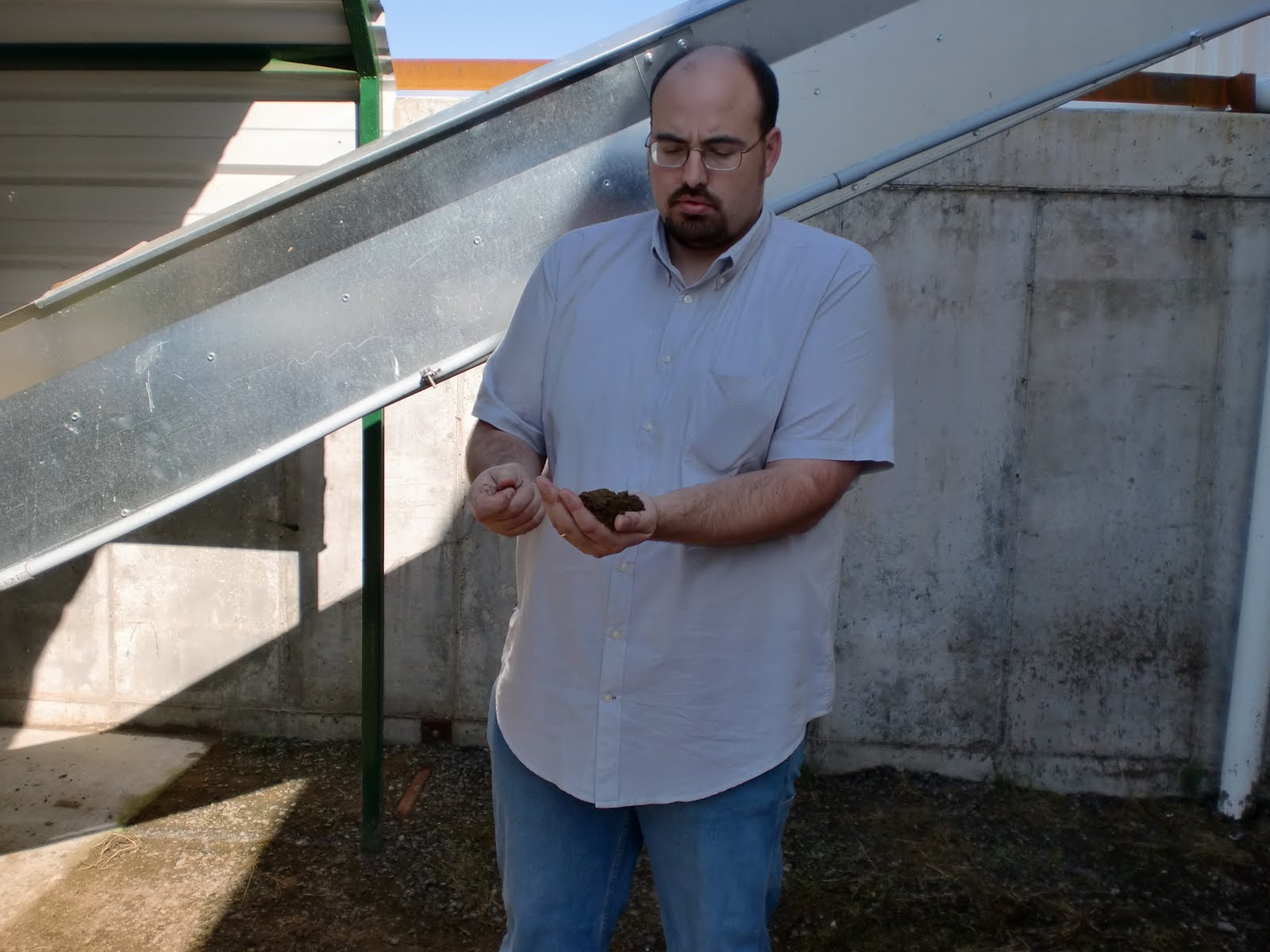
Chris Yeager with a handful of of the dry, sterile material separated from the manure.

Milking: 

Two people oversee the milking operation.  First, they check the cow's teats to make sure the milk has been let down and that there are no problems with the teats.  The teats and instruments are cleaned and sterilized.  If any problems are detected with a cow, they are not milked until approved by a veterinarian.


The milking equipment is checked every month by a certified inspector to ensure the pressure is correct so that the milking process is not painful for the cows.  Safety of the cows is paramount, and every possible measure is taken to ensure that the milking process is as clean and comfortable as it can be.
When the milk comes out of the cow it is typically 80 degrees F, and then is cooled to 37 degrees to prevent any bacteria growth. The two tanks that hold the milk get cleaned every single day. Each tank can hold up to 8,000 gallons.

Each cow's milk production is tracked each day.  Typically, a cow will produce between 30-60 pounds of milk per day, depending on age and stage in the breeding cycle.  Cows usually produce slightly more milk in the morning milking than the evening, with approximately 55% coming from the morning milking and 45% from the evening.  Tracking milk production is just one of many uses for microchip technology at the dairy.

Each cow wears a pedometer to monitor activity and other vital signs.  The micro-chips in the pedometer and the ear tag allow for a surprising amount of information to be tracked for each individual cow.  The herd managers keep really close tabs on the cows' activity levels and breeding cycles, to avoid over-milking a cow and shortening its productive lifespan.  This kind of digital herd management has raised the average productive milking life-span of a cow on the this farm to seven years, about three years more than the typical dairy cow's productive life-span.  Knowing when to avoid over-milking a cow, knowing exactly where in the breeding cycle a cow is, knowing exactly how much milk a cow has produced - these are the kinds of things that the micro-chip technology employed on the farm helps with.

Antibiotics? 

A sick cow is immediately isolated from the herd and checked by a veterinarian.  Natural remedies such as garlic, aloe vera and iodine are used whenever possible.  If the cow's health and life is in danger, antibiotics will be used to help the cow, which is then sold to another farm. 

Cows that have received antibiotics are NEVER reintroduced into the milking herd.

Processing the Milk

All the milk is taken to the Alpenrose processing plant which is only 20 miles down the road from the farm.  This is truly remarkable in this day and age, and anyone concerned with the carbon footprint of shopping choices should take note that milk is typically trucked long distances from rural farms to processing plants.  For instance, while family farmers in Oregon contribute milk to Organic Valley's "Northwest Pastures" line, their milk is trucked hundreds of miles to a processing plant in Seattle before being trucked back down to appear in Oregon stores.  When you buy organic Alpenrose milk, you can rest assured that every step of the way your money is staying in the local economy, from the dairy farmer to the processor to the distributor (our Alpenrose milk is actually delivered to us by Lochmead, another wonderful local dairy that provides us with non-organic milk and delicious ice cream).


We were impressed with how spotlessly clean the processing plant was!
 Alpenrose Packing Plant was the first plant in Oregon to package and sell organic milk.  The plant has been family owned since its beginning and many of the staff as well as the owner live at the Alpenrose site.
The plant receives tankers of milk every day, and the milk is immediately taken to an on-site pasteurization machine for the pasteurization process.  They pasteurize the milk at 165 degrees F, just slightly above the lowest legal temperature allowed of 161 degrees F, to ensure that as little of the nutritional value of the milk as possible is destroyed in the pasteurization process.  All of the waste water produced by the plant goes into a filtering pond that cleans the water, before channelling it into the sewer.  This prevents any leakage into the groundwater supply.

Alpenrose Community Spirit:

Alpenrose is extremely active in their community. They own and maintain three little league baseball fields on their property. They also host the girls Little League Softball World Series as seen on ESPN each year. There is also an Olympic-Regulation speed-bike track. There is even a Quarter Midget race track on the property! Alpenrose Dairy also hosts their Annual Easter Egg Hunt in which up to 6,000 kids and parents turn out to hunt for prizes. This hunt has been going on for 48 years now. Alpenrose sales and PR rep Tom Baker gave us a great tour and even dished us out fresh-made Alpenrose ice cream in the Dairyville Ice Cream Parlour!


Community picnics and social events are hosted on the manicured lawns, and "Dairyville" is a popular destination for birthday and holiday parties.  Dairyville is a mock western town, complete with general store, opera house and an old time ice cream parlour!  It is not open to the general public, but please call to inquire about specific events.  Visit http://www.alpenrose.com/ to learn more about the wonderful activities that are hosted on the Alpenrose property.

Tom Baker scooping the ice cream in the Dairyville Ice Cream Parlour


Monday, September 13, 2010

The Great Power Outage of 2010

On Sunday the 29th of August, an unprecedented power outage blacked out downtown Eugene and caused the Kiva to lose electricity for 14 hours.  According to EWEB, a single cable failed in an underground vault.  The resulting spark caused an electrical fire, which subsequently caused protective equipment designed to prevent a cascading outage to fail. This became dramatically obvious when three manhole covers at 11th and Pearl blew off and large plumes of smoke and flame shot up into the air.  Before the fire could be safely put out, EWEB had to turn off power to the downtown grid, leaving 28 blocks of downtown Eugene without power.  EWEB crews worked around the clock to replace more than 3,000 feet of cable and restore power to the area.


Video Footage of the Power Outage

For the Kiva, the timing of the power outage magnified its effects.  When it became clear later Sunday afternoon that the power was going to be out for an extended period of time, we spent hours on the phone, calling everyone we could think of that might be able to help.  Unfortunately, we were unable to find a way to preserve our refrigerated and frozen inventory.  We tried other grocers, vendors with refrigerated trucks, electricians, generator rentals... to no avail.  The combination of this happening on a Sunday afternoon with so many businesses already closed and so many generators already rented for the Eugene Celebration made for very unfortunate timing.  Since then, we have been making contingency plans that will hopefully ensure that if a catastrophic power outage occurs again (very unlikely), we will be ready for it.

From 2:30 PM Sunday afternoon until early Monday morning, the Kiva was without power.  The coolers and freezers on the sales floor warmed above the legal limits, and Monday morning we faced the task of tallying and getting rid of an entire store's worth of refrigerated and frozen inventory while simultaneously arranging unscheduled deliveries from local vendors to restock the store as fast as possible.  Our number one goal was to make sure that no salvageable food was wasted.  We owe a great big thank you to the Eugene Mission, Food For Lane County, Shelter Care and the East Blair Housing Coop for their help on Monday.  These charitable organizations lent their refrigerated trucks and manpower to  haul away a mountain of food. The Eugene Mission in particular returned several times as we inventoried and emptied more coolers, and they even lent us the use of their own crates.  Without their willingness to work with us in a very hectic environment, it would have been much harder to salvage and donate as much food as we did.

Our number two goal was to stay open for business and get back to normal as fast as possible.  To that end we owe a giant debt to Lochmead, Nancy's Springfield Creamery, Toby's and many other local vendors who put together orders on short notice and showed up to stock their product and get our coolers and freezers full again.  Another big thank you goes out to all the Kiva shoppers who came on down and shopped with us on Monday even though we had limited inventory.  I personally want to thank all the Kiva employees who put in a VERY hard days work and did it with a smile.  It was a difficult situation, but we made the best of it and I feel good as the Kiva manager about how little was actually wasted.

Some of you may have seen news coverage of this power outage.  KVAL news chose to focus on food being thrown in the Kiva dumpster and subsequently salvaged by dumpster divers.  The total amount of food thrown in the dumpster represented less than 10% of the total lost inventory, and mostly consisted of items from the open-faced dairy coolers that had warmed to room temperature for over six hours before the power came back on.  Nothing that could have been donated was thrown away - even charitable organizations ask that food that could potentially be a health risk not be donated.  People who were willing to risk it did organize a large group to salvage the food that was placed in the dumpster for immediate consumption.  In the end, very little food was wasted at all.

A number of customers have expressed concerns about the Kiva's ability to recover from this setback.  Let me assure everyone that we will not have to pass on any costs from the power outage to our customers in the form of price increases.  We are working with EWEB and our insurance company to recover the losses we incurred.  The Kiva is going to be just fine!

By Tuesday morning, a large order had arrived and the store was more or less back to normal.  We all collected our collective breath and moved on with business as usual.  We feel content with the knowledge that we did everything in our power to recover from the power outage as quickly as possible while donating every last item of salvageable food to local charities that could ensure the food got to those in need.  I am proud to work at a store and live in a community that values good food and pulls together in a crisis.  Thanks Eugene!


     - Carl Nash
     General Manager
     Kiva Grocery Store


Sources:
 Register Guard article (http://www.registerguard.com/csp/cms/sites/web/news/cityregion/25236647-41/power-eweb-street-avenue-east.csp)

KVAL article (http://www.kval.com/news/local/101771898.html) and Television News Story (http://www.kval.com/news/local/101834433.html?tab=video)

Personal conversation with EWEB representatives.

Wednesday, August 4, 2010

Kombucha Update

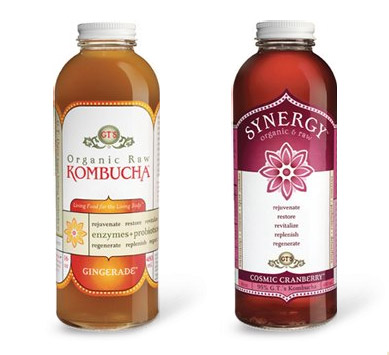
There has been a noticeable lack of kombucha in the drink coolers at the Kiva for a couple of weeks now.  On June 18th, the Whole Foods chain of grocery stores voluntarily recalled all kombucha products because of concerns that they might have alcohol contents in excess of the .5% allowed by law.  Subsequently, several major distributors and prominent kombucha manufactures such as GT's Kombucha have stopped selling kombucha while independent testing is performed and brewing practices are refined to better comply with the law.  This issue is not a health risk - while living kombucha cultures may continue to produce alcohol in the bottle after bottling, the alcohol levels do not exceed 1%, meaning you would have to drink 10 to 14 glasses of kombucha to get the alcoholic effect of a single glass of wine!  The issue is one of labeling, as special permits and labels are required to sell and manufacture beverages containing more than .5% alcohol.  There has been no government recall of kombucha and any decisions to stop selling kombucha by distributors and manufacturers have been purely voluntary.

Local kombucha manufacturer Oak Barrel Kombucha is also absent from our shelves at the moment; this is not a direct result of the alcohol issue.  Oak Barrel is taking advantage of a momentary lull in large production orders to install 400 gallons of new oak barrels for fermentation, moving toward a larger batch production that will help make individual batches more consistent.  They are also working with fermentation experts to introduce practices such as oxygenating the batches and using other advanced techniques to suppress the formation of ethanol alcohol in their batches.  If kombucha ends up being more regulated than it currently is, Oak Barrel should be fine as the result of these new improvements!  Jason and Julia at Oak Barrel are convinced that these changes to their production process will not only result in a more consistent kombucha that is always below the legal limit of .5% alcohol, but they will also result in a better product in general.  If all goes well in the installation of the new oak vats and the implementation of these changes, Oak Barrel Kombucha should be back in the Kiva by the week of August 23rd - we can't wait!

Click here to read a statement from UNFI, one of our distributors, regarding their decision to stop selling GT's and other kombucha products for the time being.

Click here to read the statement from the Alcohol and Tobacco Tax and Trade Bureau regarding alcohol content in kombucha.

Wednesday, July 28, 2010

McKenzie River Organic Farm

The Kiva has long been a supporter of local farms.  When McKenzie River Organic Farm approached us a while back about carrying their delicious organic blueberries year round in our freezers, we jumped at the opportunity.  Today we carry other fresh produce from the farm as well as blueberries, when seasonally available. Local business liason Tom and produce buyer Lauren recently visited the farm, and they brought back some great pictures and information to share with you.


The McKenzie River Farm was originally planted in 1952. 16 years ago, when Douglass Moser and Carol Ach bought the farm, it was overran with blackberries. The blueberry bushes were untrimmed and overgrown. Since then these family farmers have made it into the beautiful and well cared for farm you can see today at 44382 McKenzie Highway. Between their farm and a neighboring plot that they rent they have around 5,000 blueberry bushes. Douglass died 3 years ago, but he was the driving force behind the farm and is responsible for much of its current momentum.

Left to Right: Sam, Carol and Jack
The farm is a true family run farm, owned and operated by Carol and her sons.  Today the day-to-day farm operations are overseen by Carol's sons Jack and Sam. Every night they have their own farm-to-table as they sit down and eat their own food as a family. Not only is the farm certified organic, but they practice biodynamic methods of planting and harvesting as well.  Sustainability is important to the family, so they create compost from their cow manure and are working towards a closed system where waste is reused to satisfy all fertilizer and soil amendment needs.   Jack describes the farm operation succintly;

"We are organic rednecks growing organic food using biodynamic practices."

Now that her sons are assuming control of the family business, Carol plans to start a school for farmers and dreams of founding a Farmers' Retirement Home where old farmers can eat good food. Carol believes that traditional schooling methods cannot teach farming. Sitting at a desk under the wrong light will not get the job done. She envisions a school where farming is learned through practice out in the fields. Carol observed that farming is a very skilled activity, including knowledge not just of growing crops but of maintaining soil fertility and saving seeds.

McKenzie River Farm produces between 4-500 pounds of picked, cleaned and sorted blueberries a day during the season.
They also raise cows, chickens and pigs on the farm and sell farm products and their own fresh produce at their farm stand. They have grapes, figs, apples, pears, peaches and more! You can buy their local fresh salad greens year round at the stand, as well as pure blueberry juice (they bottle about 200 gallons of pure blueberry juice each year).
Their u-pick business has been increasing every year, and between u-pick, people buying berries at the farm stand and the three farmer's markets they attend, over 70% of their total berry sales are accounted for. They sell at the Tuesday and Saturday Farmers' Market in Eugene and the Friday Farmers' Market in Springfield.  Repeat customers from as far away as Sisters and Roseburg come every year to their u-pick field!
Lauren in the U-Pick Field


We sell McKenzie River Farm organic blueberries frozen and dried in bulk year round and fresh in season (come on down and get 'em while they're hot!)

As of today, we also have beets and turnips grown at McKenzie River Farm in our produce section.

McKenzie River Organic Farm Contact Information:

Address:  44382 McKenzie Highway, Leaburg, OR 97489
Phone:  541-896-3928